
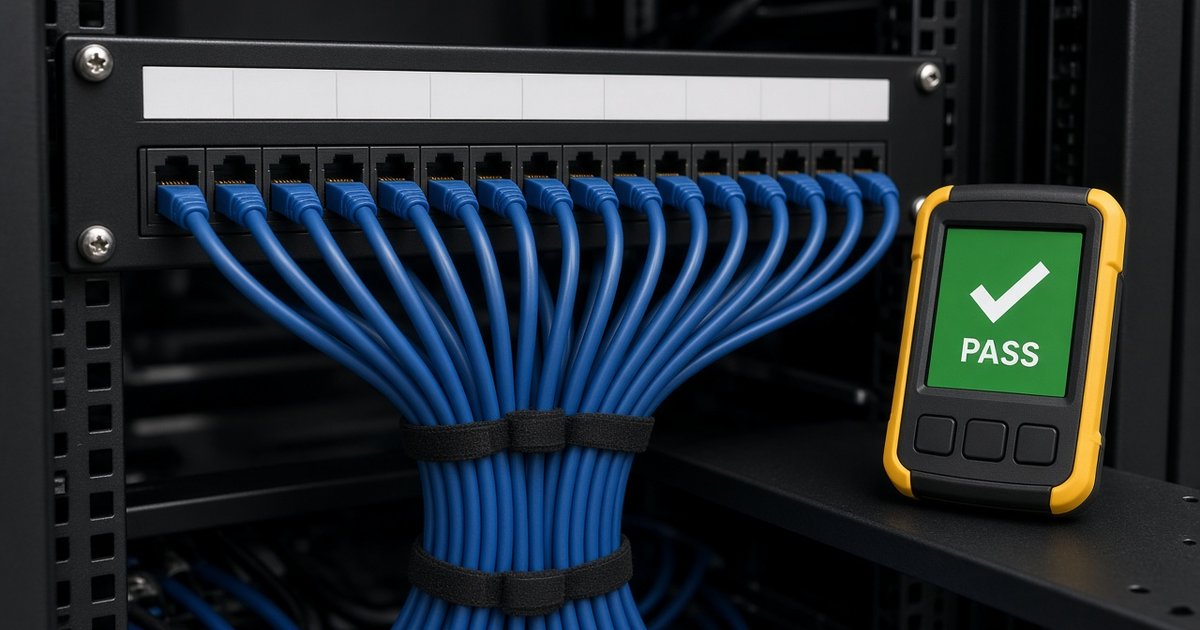
If you're moving into a new office, doing a tenant upfit, or finally fixing that rat's nest of cable in the back closet, someone's going to ask you a question: "Cat6 or Cat6A?" They look almost the same on the spool. They plug into the same jacks. But they aren't the same cable, and picking the wrong one can mean re-pulling wire in a few years.
I've been an electrician for 25 years, and here's the plain-English version of what you need to know before you sign off on office network cabling.
#What's the Difference Between Cat6 and Cat6A?
The "A" stands for "augmented." Cat6A is basically Cat6 built to a tougher standard.
- Bandwidth: Cat6 is rated to 250 MHz. Cat6A is rated to 500 MHz, about double.
- Speed at full length: Both handle 1 Gigabit Ethernet to the full 100 meters (about 328 feet). The difference shows up at 10 Gigabit.
- Crosstalk: Cat6A is designed and tested to control "alien crosstalk," which is noise that leaks between cables bundled together. That's the main thing that holds Cat6 back at higher speeds.
#Is Cat6A Faster Than Cat6?
Sort of. Both can run 10 Gigabit Ethernet (10GBASE-T). The catch is distance. Cat6 only supports 10 Gig over shorter runs, roughly 37 to 55 meters (about 120 to 180 feet), and even less if it's packed in a tight bundle. Cat6A supports 10 Gig over the full 100-meter channel. So on a short run they can match, but on a long run down a hallway to the far end of the office, Cat6A keeps the speed and Cat6 may not.
#How Far Can Cat6 Run 10 Gigabit?
This is the question that decides most jobs. In a typical Spartanburg or Greenville office, a lot of runs from the network closet to the far desks, conference rooms, or ceiling access points go well past 55 meters once you count going up the wall, across the ceiling, and back down.
If your network today is all 1 Gig, Cat6 will work fine at those lengths. But switches, Wi-Fi access points, and servers keep moving to 2.5, 5, and 10 Gig. If you want any long run in the building to be ready for 10 Gig, Cat6A is the cable that's actually rated for it.
#Is Cat6A Shielded?
Not always. That surprises people. Cat6A comes in two main flavors:
- UTP (unshielded): No foil. Easier to install and very common in offices.
- Shielded (F/UTP or S/FTP): Has foil around the pairs or the whole cable. Good near heavy electrical noise like motors, big transformers, or shop equipment.
One important thing: shielded cable only helps if the shield is bonded and grounded properly from end to end. A shield that isn't grounded right can do no better than plain UTP. That's one place where having an electrician on the cabling job pays off.
#Is Cat6A Bigger and Harder to Install?
Yes. Cat6A is thicker, usually around 7 to 8.5 mm across compared to about 5.5 to 6 mm for Cat6. It's often 23 AWG, sometimes 22 AWG. That means:
- Fewer cables fit in a conduit or J-hook
- It needs a wider bend radius (kinking it hurts performance)
- It's heavier on supports
- It needs Cat6A-rated jacks and patch panels. Cat6A cable on Cat6 jacks doesn't give you a Cat6A link.
None of this is a dealbreaker. It just has to be planned before the walls close up.
#Is Cat6A Better for PoE?
Power over Ethernet (PoE) runs power and data down the same cable. Cameras, access points, phones, and door readers use it. The newer IEEE 802.3bt standard pushes up to 60 watts (Type 3) and 90 watts (Type 4) at the power source.
More power means more heat in the bundle, and heat increases signal loss. Cat6A's better loss performance and larger build handle that heat better, which is why it's the usual pick for high-power PoE across lots of devices. Cat6 can still do PoE, but long, hot bundles may need shorter runs.
#Is Cat6A Backwards Compatible?
Yes. Cat6A uses the same RJ45 plug, and it works with older Cat6 and Cat5e equipment. Just remember your network only runs as fast as its weakest piece, so every jack, patch panel, and patch cord in the link matters.
#So Which One Should Your Office Use?
Here's how I'd think about it:
Cat6 can make sense if:
- Runs are short
- You only need 1 Gig (or 2.5/5 Gig) and have no plans for more
- The space is temporary
Cat6A is the better pick if:
- It's a new build or tenant upfit you plan to stay in for years
- Runs are long or cables are bundled tight
- You're adding Wi-Fi access points, cameras, or other PoE gear
- You want 10 Gig ready anywhere in the building
For most new office network cabling, we recommend Cat6A. Industry standards point the same way for new installs. Pulling cable once is a lot cheaper than opening ceilings later.
#How Tessco Handles Cat6A Installation in Spartanburg and Greenville SC
At Tessco Construction, we handle Cat6A data cabling for offices and businesses in Spartanburg, Greenville, and across the Upstate. We label every run at both ends and test it before we call it done. So when something needs to move or gets troubleshot later, nobody has to guess which cable goes where.
Because we're electrical and general contractors, one crew can handle both the electrical and the data on a tenant upfit. That means fewer trades to schedule and the power and data get planned together. We've done electrical and data work at several UPS Store locations, and we bring that same approach to offices across the Upstate.
Planning a move, upfit, or cabling refresh? Get Estimate
#FAQs About Cat6A Installation
Do I need Cat6A for a small office?
Not always. If runs are short and you only need 1 Gig, Cat6 can work. But if you're planning to stay a while or add PoE devices, Cat6A is the safer long-term choice.
Can I mix Cat6 and Cat6A?
Yes, they'll work together, but the link performs to the lowest rated part. To get true Cat6A performance, the cable, jacks, patch panel, and cords all need to be Cat6A rated.
Does Cat6A need to be shielded?
No. Unshielded Cat6A is common in offices. Shielded is useful near heavy electrical noise, but it has to be grounded correctly to work.
Why should data cabling be tested?
A link light only tells you the cable connects. Testing checks that each run actually performs to its category, so you know the cabling you paid for is the cabling you got.
#FAQs About Tessco Construction
Is Tessco Construction licensed and insured?
Yes. Tessco Construction is licensed and insured, and we're happy to provide license numbers on request.
Do you offer a warranty?
Yes. Our work comes with a 1-year parts and labor warranty.
What areas do you serve?
We're based at 2424 S Pine St, Spartanburg, SC 29302, and serve Spartanburg, Greenville, and the rest of the Upstate within about 30 miles. We also take on larger commercial jobs across South Carolina, North Carolina and Georgia. For data cabling, electrical, or tenant upfit work, call (864) 316-6031 or tap Get Estimate.
What else does Tessco do?
Commercial and residential electrical, tenant upfits, general construction, and standby generators. We're a certified Generac dealer.
Ready to talk about your office network cabling? Get Estimate